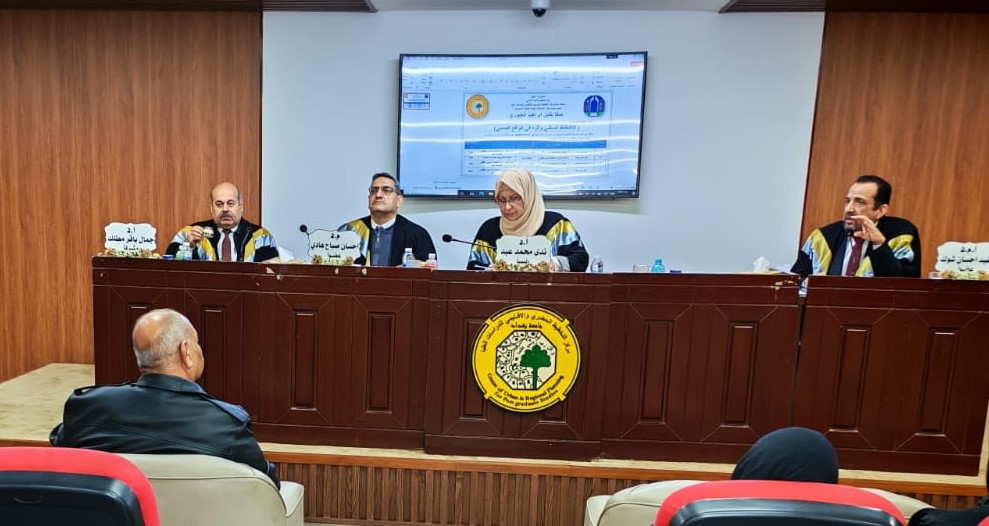
The Center of Urban and Regional Planning for Postgraduate Studies at the University of Baghdad discussed the Master’s thesis entitled “Population Overcrowding and its Impact on Health,” submitted by student Safaa Khalil Ibrahim, under the supervision of Professor Dr. Jamal Baqir Mutlaq. The thesis aimed to identify the factors contributing to population overcrowding and their relative importance in order to address and mitigate the effects of this phenomenon on the psychological and physical health of residents.
In her thesis, the student discussed the most important factors of population overcrowding, such as the number of family members and the number of families per dwelling, as well as monthly income levels and other urban planning factors like residential land area, building area, number of bedrooms and beds, and other related factors. A questionnaire was developed using a systematic random sample of families residing in the Al-Shula neighborhood, block 640, in Baghdad. The results showed that some variables, such as monthly income, did not significantly influence overcrowding. However, the number of individuals per dwelling, the number of families, and the number of households within a single house all had a significant impact. The study also examined the health consequences of overcrowding, including the ease with which infections such as influenza, stress, and other illnesses spread.
In her thesis, the student recommended regulating migration and population distribution, supporting low-income families in obtaining suitable housing, and implementing United Nations standards in housing projects to achieve the principle of decent housing and reduce overcrowding, thereby improving quality of life. She also recommended conducting similar studies to compare different areas and generalize the results to achieve spatial justice, taking into account the cultural, social, economic, and urban characteristics of each area, as well as the specific issue of overcrowding.