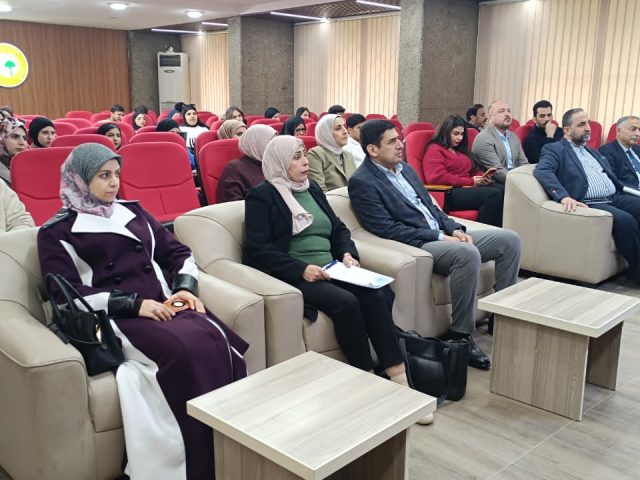
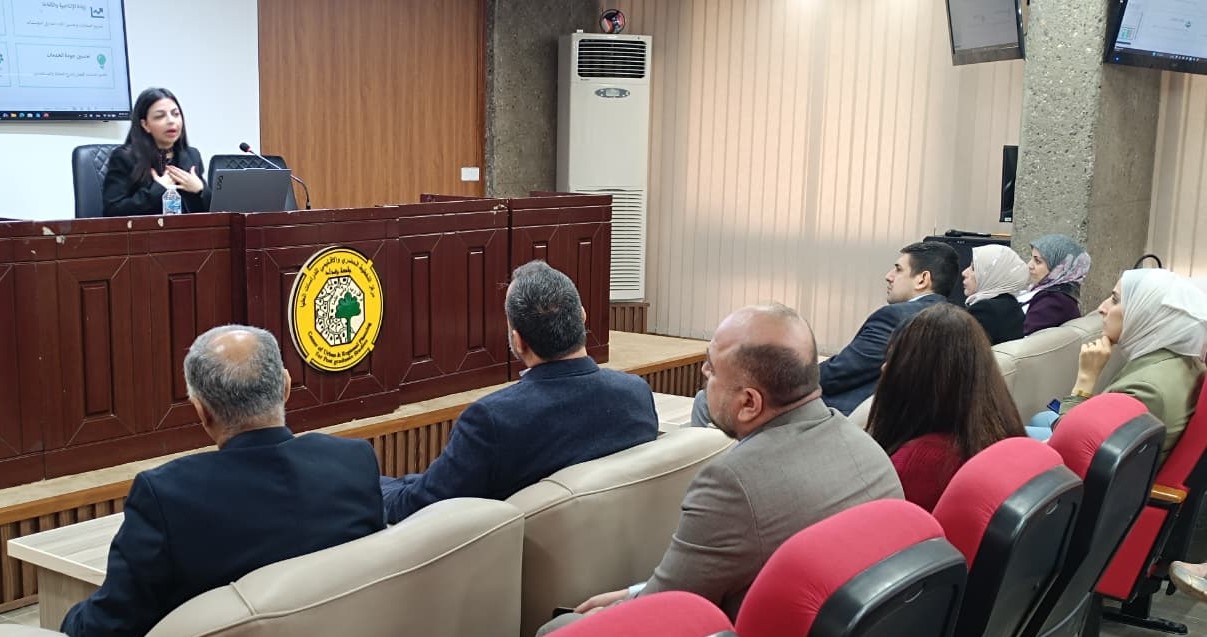
The Center for Urban and Regional Planning for Postgraduate Studies at the University of Baghdad held a workshop titled “Artificial Intelligence and Automation,” presented by Assistant Lecturer Najwa Sadiq, as part of the Leadership and Innovation Week activities organized by the center. The workshop, attended by faculty and staff, aimed to clarify the concepts of artificial intelligence and automation, highlighting their differences and integration, and emphasizing their role in improving efficiency and supporting decision-making, as well as solving complex problems in various sectors (especially GIS and planning).
Sadiq also addressed the fundamental difference between AI and automation, explaining when automation and artificial intelligence are used, and highlighting the value of integrating them in practical applications and developing students’ analytical thinking by connecting theoretical concepts to real-world applications.
The workshop concluded with a set of scientific recommendations that emphasized the need to include artificial intelligence and automation in university curricula, focusing on the applied rather than the theoretical aspect, using real-world case studies. The technical recommendations focused on not completely replacing human decision-making with intelligent systems and starting with automation before moving to artificial intelligence, as well as choosing the technology according to the nature of the problem. The research recommendations addressed encouraging research that integrates GIS with AI and developing predictive models that support sustainable planning, in addition to studying the social and economic impact of artificial intelligence to build human capabilities before adopting technologies, while establishing clear policies for the use of artificial intelligence to enhance cooperation between the academic and practical sectors.