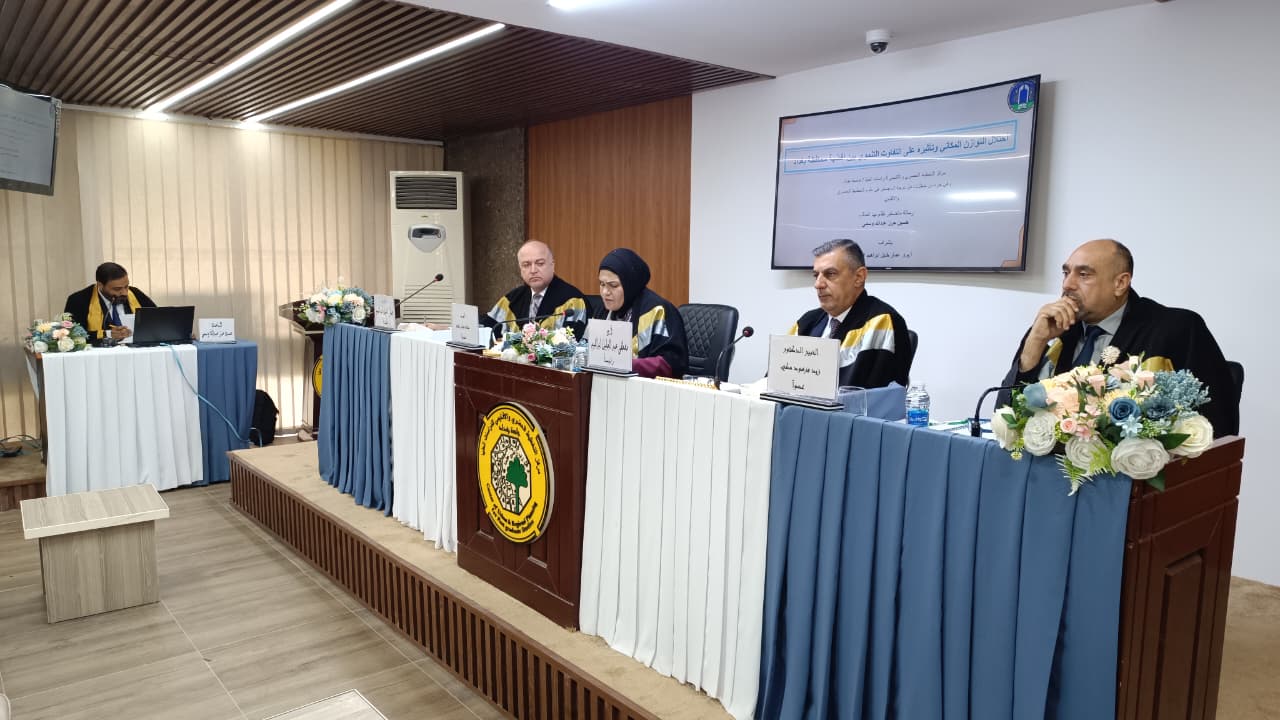
The Center for Urban and Regional Planning for Postgraduate Studies at the University of Baghdad witnessed the discussion of a master’s thesis entitled “Spatial Imbalance and its Impact on Developmental Disparities Among the Districts of Baghdad Governorate,” submitted by student Hussein Harz Abdullah and supervised by Assistant Professor Dr. Ammar Khalil Ibrahim.
The thesis aimed to study the phenomenon of spatial imbalance among the districts of Baghdad Governorate and its impact on developmental disparities in economic, social, service, and environmental activities. It also focused on analyzing patterns of resource and service distribution and infrastructure to reveal spatial differences and the extent of the developmental gap between them.
The student demonstrated in his thesis a clear developmental disparity among the districts of Baghdad, where these districts suffer from a severe lack of basic services and infrastructure. This reflects a lack of spatial balance in development. Furthermore, the concentration of economic activities and services in limited areas has led to weak spatial diversity and increased pressure on urban centers due to population migration from the periphery. This has contributed to weak integration between sectoral and spatial planning and the absence of an up-to-date database, further exacerbating this gap.
The thesis recommended the importance of adopting spatial balance as a fundamental pillar in development planning policies, activating the role of spatial planning at the local and regional levels, addressing service disparities after involving academic and research institutions in formulating spatial development strategies, enhancing the environmental dimension in development plans by protecting natural resources and ensuring their sustainability for future generations, redirecting government investment towards districts after adopting spatial justice as one of the basic principles in the distribution of projects and services, as well as involving local residents and municipal councils in identifying development needs and priorities, with periodic updates of statistical and spatial data for all sectors.