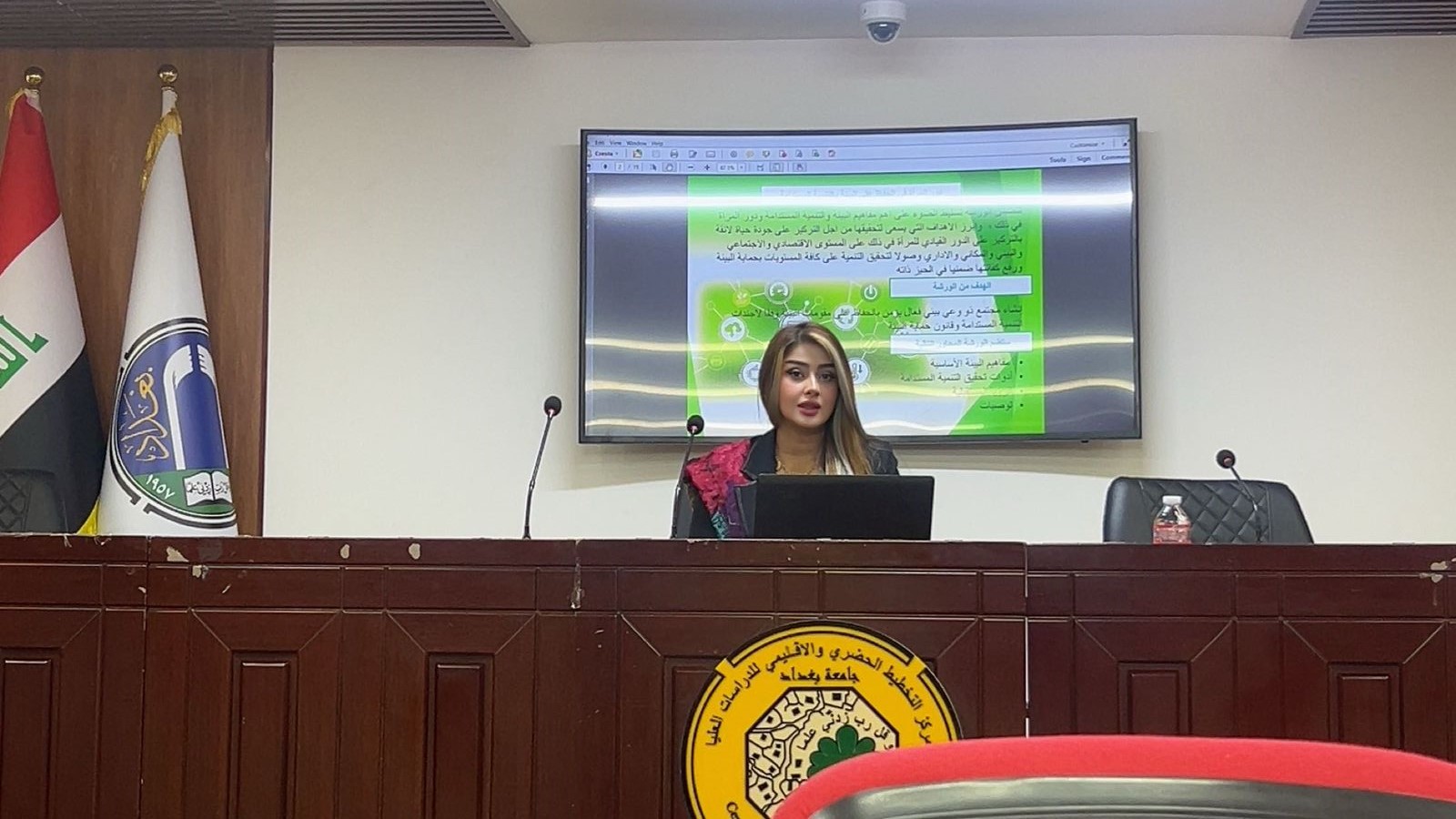
The Women’s Affairs Unit at the Center of Urban and Regional Planning for Postgraduate Studies at the University of Baghdad held a workshop entitled “The Role of Women in Environmental Conservation and Sustainable Development.” The workshop was presented by Dr. Inas Dhia Hadi, Head of the Human Rights Unit at the Center, and attended by a number of faculty members and staff. The workshop aimed primarily to highlight the pivotal and leading role of women in addressing contemporary environmental challenges, enhance their capabilities in the sustainable management of natural resources, integrate a social diversity perspective into national environmental and climate plans and policies, and encourage green feminist initiatives.
Dr. Hadi emphasized that women play a fundamental and central role in managing spaces, whether in the workplace or at home. Their role includes managing household resources by conserving water and energy efficiently through reuse practices such as recycling, energy management, water conservation, and maximizing the economic impact of crafts and handicrafts. Furthermore, she highlighted their potential in socially managing human resources by establishing supportive relationships based on interaction and effective communication, which transforms challenges into opportunities and fosters a positive environment conducive to progress. The workshop concluded that excluding women from environmental planning weakens the effectiveness of proposed solutions. Women are not merely a group affected by climate change, but a driving force for change, provided there is a genuine partnership to activate coordination between governmental and non-governmental bodies to ensure women’s participation in national climate policy-making committees.
Dr. Hadi concluded the workshop by stating that environmental challenges necessitate significant changes in the design of women’s roles within school curricula and their implementation in educational institutions. Women’s leadership role in the environment must be strengthened by modern technologies such as artificial intelligence and information technology, which help them find proactive solutions to environmental problems. Recent scientific research indicates that green education increases women’s awareness of the importance of sustainability and the impact of their decisions on the environment. Strengthening women’s role in society is an effective way to stimulate innovation and creativity, encouraging individuals to think of new solutions that contribute to creating a generation capable of developing a range of strategies to address environmental challenges.