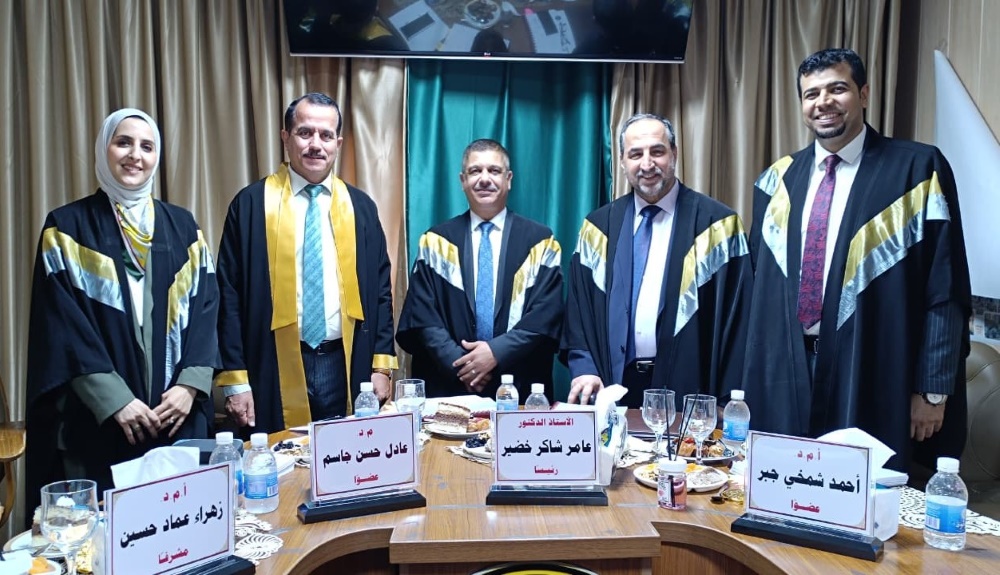
The Center of Urban and Regional Planning for Postgraduate Studies at the University of Baghdad discussed the Master’s thesis entitled “The Impact of Cultural Diversity on the Urban Landscape: An Analytical Study of Kirkuk City,” submitted by student Hajim Hamed Ali, and supervised by Assistant Professor Dr. Zahraa Emad Hussein.
The thesis aimed to analyze the impact of cultural diversity, with its four elements (language, religion or ethnicity, customs and traditions, and urban development), on the urban landscape, both materially and intangibly, within an analytical framework that combines cultural and urban perspectives.
The student’s theoretical component relied on a conceptual analysis of cultural diversity and the urban landscape of Kirkuk, based on scientific literature and urban and cultural geographical studies. The practical component of the thesis was supported by a field study conducted in Kirkuk using spatial and qualitative analytical tools, such as Geographic Information Systems (GIS) and interviews, to monitor the extent and distribution of the elements of diversity and analyze their qualitative impact on the city’s urban landscape.
The thesis concluded that cultural diversity in the city of Kirkuk is not a formal or statistical phenomenon, but rather an active factor in shaping the urban landscape and can be a tool to enrich it or a cause of its disruption depending on how it is dealt with. Thus, the student recommended in his message the necessity of integrating urban diversity to achieve social cohesion and support urban identity, as well as to improve public spaces.