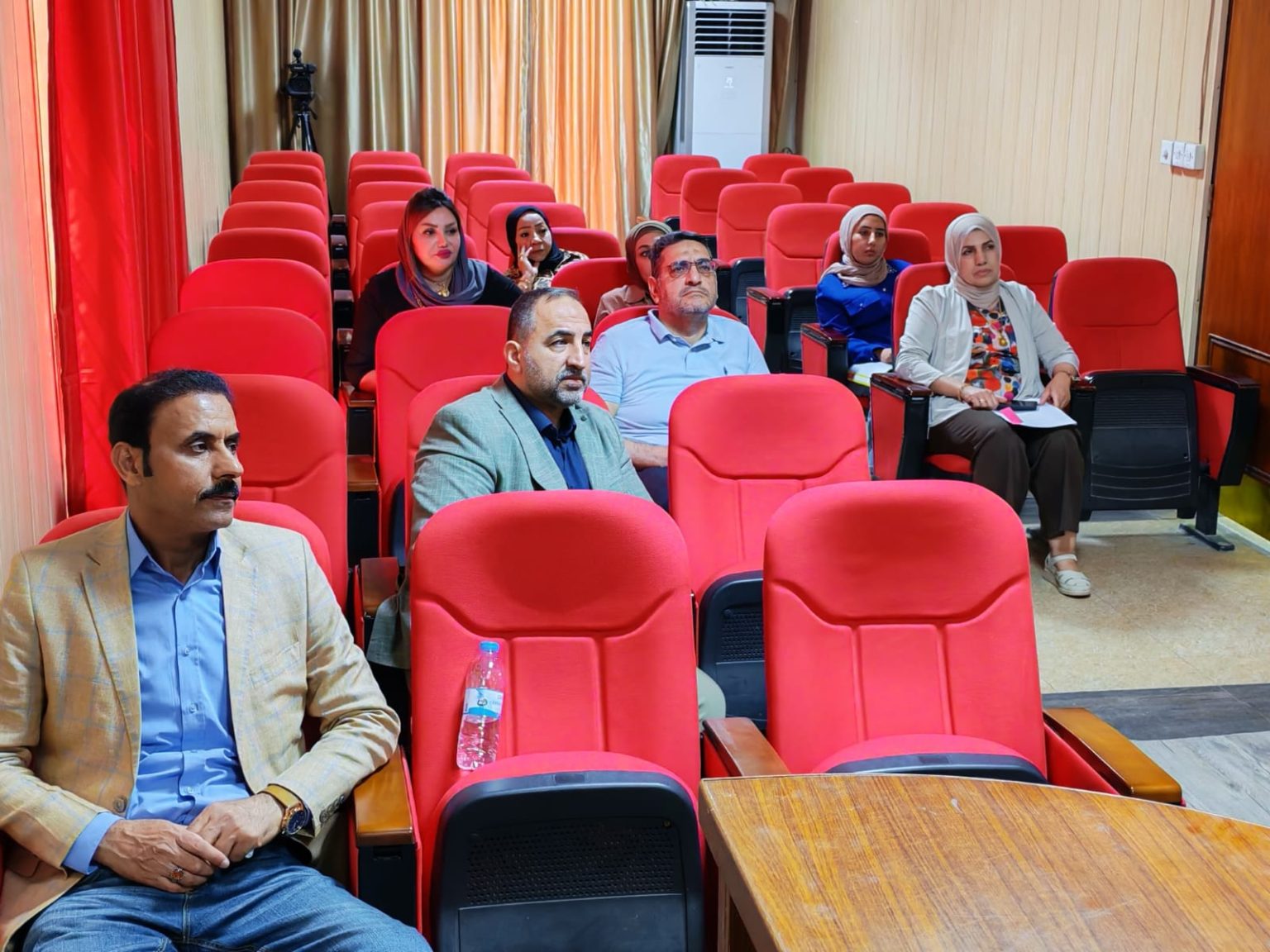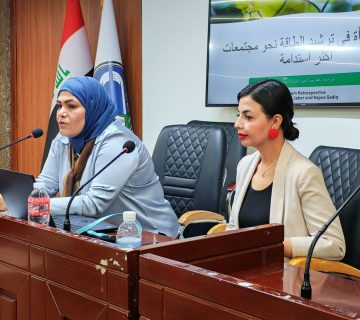

The Quality Assurance Unit at the Center of Urban and Regional Planning for Postgraduate Studies at the University of Baghdad held a training workshop entitled “Realistic Sustainability in Arab Countries.” The workshop was presented by Assistant Lecturer Maha Amer from the Center and Assistant Lecturer Noor Raad from the Department of Studies and Planning at the Iraqi University, and was attended by faculty and staff members of the Center.
The workshop aimed to introduce the evolution of the concept of sustainability and its intellectual and practical transformations, and to discuss the reality of sustainability implementation globally and in the Arab world. It also analyzed the challenges facing the achievement of sustainability goals, clarifying the concept of realistic sustainability as a practical approach that considers local capabilities. Furthermore, it explored post-sustainability ideas such as uncertainty, generation rather than conservation, dynamism, and others, while encouraging participants to think critically about traditional planning models.
The workshop’s themes were as follows: the first focused on the origins of the sustainability concept and its intellectual transformations; the second discussed sustainability globally in terms of thought and trends; the third highlighted more flexible and contextually relevant intellectual approaches; and the fourth explored the transition from idealized sustainability to more realistic approaches relevant to the Iraqi context. The two lectures, by Amer and Raad, addressed the concept of sustainability from a critical and realistic perspective, focusing on the gap between theoretical models and the actual challenges facing Arab countries, and Iraq in particular. These countries are striving to reinterpret traditional sustainability concepts in light of contemporary economic, social, and environmental transformations, leading to the introduction of concepts such as realistic sustainability and post-sustainability as more flexible approaches capable of adapting to the changing reality.
The workshop concluded that global sustainability models cannot be applied uniformly across all countries, as sustainability priorities vary according to economic, social, and political contexts. While Arab countries face complex challenges that limit the effectiveness of traditional sustainability practices, the Iraqi context requires gradual and flexible approaches rather than rigid, idealized models. Realistic sustainability is achieved through sound planning, not by relying on expensive technology and elite certifications, while attempting to reconcile available resources with development aspirations. Future planning demands more flexible systems capable of dealing with uncertainty and continuous change.