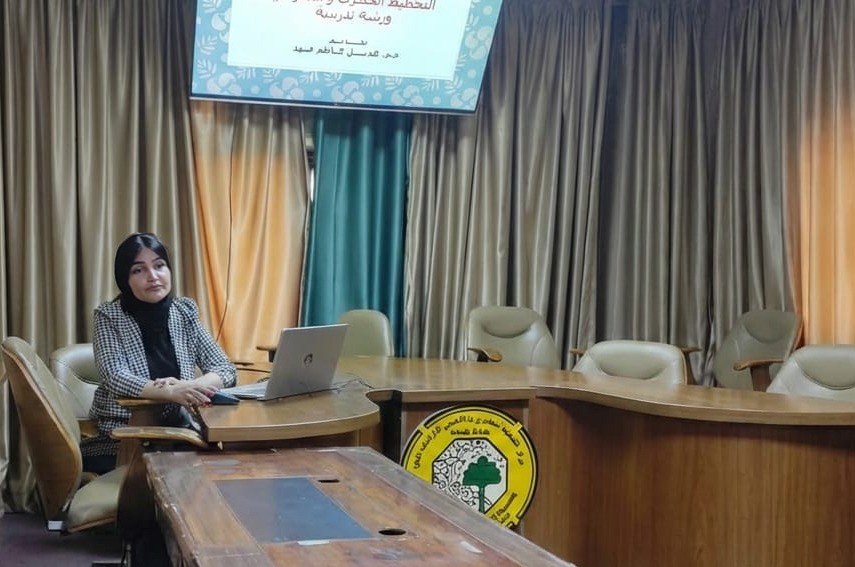
The Center of Urban and Regional Planning for Postgraduate Studies at the University of Baghdad organized a workshop titled “Arab Heritage in Spain – Urban and Regional Planning.” The workshop was presented by Assistant Lecturer Hadeel Kadhim Fahd from the Center, and was attended by a number of professors and staff members.
The workshop aimed to highlight the role of Arab architects in Europe, particularly in Spain, during the period of Islamic rule in Andalusia. This period had a significant impact, especially on urban and regional planning in Spain, and its influence remains evident in many Spanish cities. Arab cities of that era were designed with advanced methods, featuring narrow streets and closely packed houses, reflecting the social nature of the Arabs and their urban planning principles, which emphasized social cohesion.
Fahd emphasized that Arab markets in Spain were bustling and vibrant, combining commercial and cultural elements. These markets were often home to mosques with unique designs, serving as centers for worship and education. The Arabs in Andalusia utilized designs featuring domes, arches, and Islamic motifs, employing stone, brick, and wood, in addition to incorporating water features such as fountains. The workshop showcased the most beautiful Arab-Islamic landmarks in Spain, such as the Great Mosque of Cordoba, the Great Mosque, the Alhambra Palace, the Madinat Azahara Palace, and the Tower of Gold, as well as the Aljafería Palace in Zaragoza, the Alcazaba Castle in Malaga, and the Bab al-Mardum Mosque, or the Mosque of the Light of Christ.