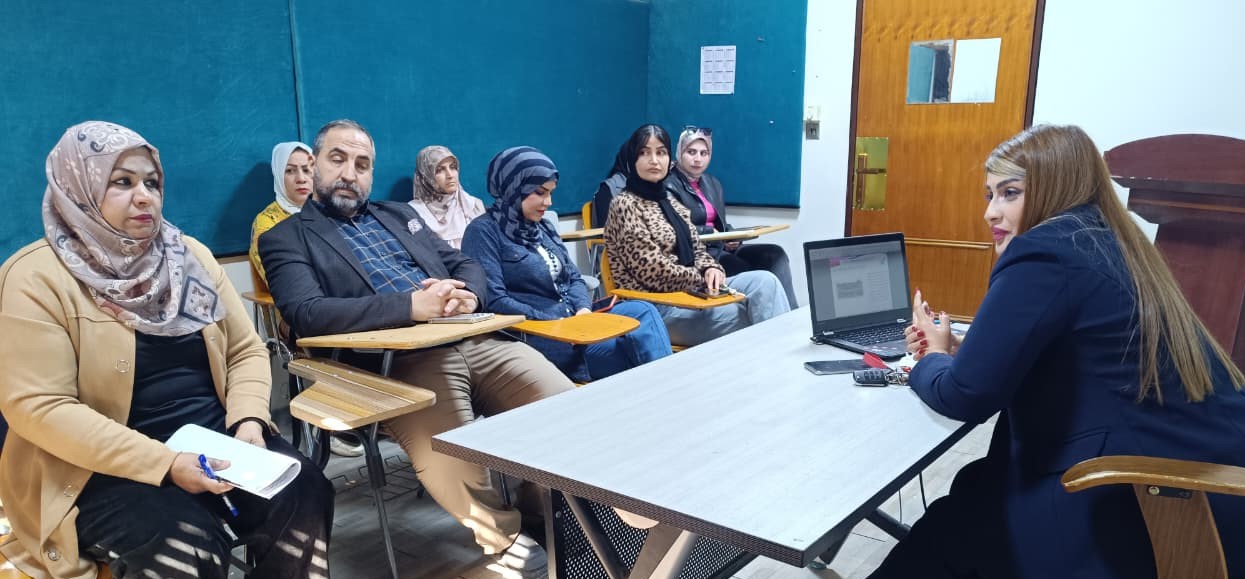
The Center of Urban and Regional Planning for Postgraduate Studies at the University of Baghdad held a workshop entitled “Open Urban Spaces,” presented by Dr. Inas Dhia Hadi, Head of the Human Rights Unit at the Center. The workshop was part of the Leadership and Innovation Week activities organized by the Center and attended by its faculty and staff. The workshop aimed to optimize the use of open urban spaces to enhance the city’s urban appeal and activate spatial activities in the best possible way to serve the community.
Dr. Hadi highlighted the concept of open urban spaces, their connection to significant events, their nature, and their contribution to the city’s present and future. She also discussed their impact on the functional, human, and social needs of those who frequent the city. Open urban spaces are defined as areas not designated for specific functional activities, which contribute to improved performance by being allocated for diverse activities such as recurring or unexpected events, national and international celebrations, and annual events. The most important recommendations included the importance of involving the local community in the design and planning of public spaces to ensure they meet the actual needs of residents, taking into account the needs of women, children, and the elderly. This also included allocating spaces for walking and shopping, and achieving a balance between private investments and open public spaces in popular and older neighborhoods.
The workshop also emphasized the necessity of using environmentally friendly and recyclable building materials and integrating sustainability elements by utilizing natural light and reducing the need for artificial cooling and heating. Furthermore, it highlighted the importance of creating spaces that allow rainwater to drain and collect to increase water reserves, and distributing trees and plants in a way that enhances views and the overall landscape without obstructing activities. Finally, the workshop stressed the importance of incorporating artistic elements such as sculptures and statues in parks to beautify urban spaces, while encouraging cultural and social activities and events to revitalize these spaces.